
Rob is a product and multidisciplinary design leader with over 20 years experience building things you’ve probably loved.






































Building for small business through data-driven account-tech
Small business has a big problem. They’re high risk. They’re so high risk that the majority fail within five years of incorporation. The reason that the majority of small businesses fail is complex. Some simply fail because their owner isn’t good at business. Some fail because the market rejects their offering. But if you have a business that is viable - and you have some business acumen then your biggest risks are - making bad decisions and a lack of access to capital.
Most business owners make bad decisions, not because they don’t seek out good advice - but because they don’t have the right numbers in front of them to make a good decision.
Most business owners lack access to capital because, as a whole, small business is high risk. For a bank or lender, the general risk is often not worth engaging with. For a viable business, they lack the ability to de-risk themselves from their contemporaries. Risk is a numbers game, and the house always wins.
Quota was founded to resolve that weighted bet, and it resolves it through providing small business owners with SPOT - a single point of truth in their business data, that can be verified by banks and lenders and underwritten by accountancy professionals.
Accountancy professionals are uniquely placed to validate small business data. They’re also uniquely trusted by banks and lenders. Accountancy professionals are also in a race to the bottom - stagnant pricing and the threat of AI is undermining their business models, and their only respite is to move up the value chain towards offering services that mom and pop bookkeepers cannot offer.
So the problem space Quota finds itself in is rather unique and multi-sided. It serves the small business owner, it serves the lender. But it also serves the accountancy professional. And it is the accountancy professional who ultimately drives Quota - in both its legitimacy and reach - to the small business owner and the lender.
Quota is a heavy data product. It’s also a finance product. It’s a product where precision wins and errors can cause real life pain. It relies on complex data connectivity with dynamic ledgers and bank APIs, and it requires incredibly deep categorization models to provide the insights required by those making large capital decisions.
In short, Quota is Bloomberg Terminal for SMB. But it’s a Bloomberg terminal simultaneously used by a highly qualified accountancy professional and a business owner with a financial knowledge largely limited to ‘number go up’.
My role on Quota was broad and it encompassed leading Product and Design from the position of co-founder.

Quota allows Accountancy professionals to quickly onboard businesses through automatic connections to QBO and Xero.

From there, Quota automatically maps the history of the company using a proprietary codec called QCS. QCS is a complex beast of a codec that required very stringent information architecture. That architecture then is able to generate a parser logic, which can be leveraged by AI query engines.

This complexity is hidden in Quota - the categorization, the logic paths - to generate a smooth onboarding experience where the Accountancy professional is able to input, connect, sync and categorize any small business in under four minutes. Quota is also able to handle interdependency between types of businesses, industries and connected businesses, such as franchises and groups of companies.

This means for the Accountancy professional, businesses can be compared, reports generated and up-market advice created at-a-glance. However the big win for most Accountancy types is the way which, thanks to the QCS codec, any business on the platform is instantly compiled. A compilation in most industries is the financial standard for investment of any type, and for most Accountants, a compilation is (a) time consuming to produce (b) has very slim margins and (c) is immediately out of date at the point on compilation. Quota provides real time compilations for every connected business.

QCS also powers the finite details behind equations. It’s able to show past and future trends per equation with tabular detail.

For analysts who require additional details into individual numbers and QCS outputs, X-Ray mode provides the granular breadcrumbs. With X-Ray in QCS the analyst is able to leverage QCS to ‘no code’ the ledger. The AI agent QAI also leverages this X-Ray layer, able to allow for general prompts by both the Accountancy professional and small business owner.

What’s fascinating about Quota, and QCS as a codec in general is the power that exists within the codecs ability to find patterns within the abstracted data - and for that I thank the analytic mind of my PM Jay Dort. This allowed us to build smart budgeting tools based on prediction models, effectively running spread-bets against a company ledger, and allowing QCS to amend its variables when the budget was made actual.
The most interesting thing for me with Quota was the creation of flows. In product design and product generally, we talk about flows in terms of usability and execution. What you can see. What is tangible. What is human. In Quota those flows are the data itself, and the usability is determined by the way by which that data is not only presented but how that data is referred to, architected and made accessible in a variety of deep-use cases. The product challenge then becomes understanding the data layers, understanding where the leverage is and understanding what is possible.
In many ways QCS - and Quota - is a pure design product, but a design product with no true visible render. Where the aesthetic is the function and that function can be anything.
I intend to write more about QCS and Quota in the near future.

Talking Citymapper, Smartbus, China and IDEO at Hong Kong Design Week

I've spoken at quite a lot of conferences (and enjoy the design advocacy game in general), but I'm pretty sure that KOWD in Hong Kong wins the prize for best conference speaker host. I was in Hong Kong to speak about Open Data and design systems for smart cities with Citymapper, and while there got to speak with (and workshop with) some great minds from IDEO, the University of Austin and Ford Motor Group. Here’s a redux of that talk, with converted presenter notes and some key slides.

“My name is Rob I lead Special Project Design at Citymapper. My job at Citymapper is to not only lead Design, but to build global, scaleable products and experiences that make cities useable. Citymapper is in over 39 cities with millions of daily users, and the app has become known globally as the interface of choice in cities our users know well, and new cities they're just discovering.”
“I’m honoured to be invited by the Hong Kong Knowledge on Design Festival and the Government Hong Kong to talk about how we navigate complex cities.
In many ways this is a futuristic talk. Even a few years ago we wouldn’t be having this kind of open discussion. Citizens would use local knowledge to make sense of their city, and that would be that. If you were a visitor to a city, except for guidebooks, you’d never have local first hand knowledge of how to navigate a living, breathing complex city. Now we’re overwhelmed with the choice of ways to discover and understand our cities; from transit, to food, to taxis to hyper-local reviews.
So, with such a broad topic to talk about, I have to start somewhere. So I’m going to start with a fact.”

“Here’s what we know. Citizens are smart. They proudly, holistically know their city. They use apps to explore their city. They use social networks to see their cities in different ways, meet people, discuss things they love, date - and they also by doing so - change their city. Smart citizens make cities smart. Smart cities don’t exist without smart citizens.”

“Therefore if Citizens are smart - Cities are smart. Part of the user experience of smart cities - what actually makes cities ‘feel’ smart - is for the smart citizen to see the city change, but also to witness themselves change the city. Through using products like Facebook, Twitter, Instagram, Tinder, Foursquare, Yelp - and products like Citymapper - smart citizens use data to create experiences in the city, which in turn can make a restaurant successful, a bus busy, and following that logic - an area expensive to live in. This is a constant feedback loop, and a feedback loop is essential to create any great user experience. “

“This is important to note. We can build apps, we can add interfaces, but it is simply not enough to make the invisible visible. To make data visual. We cannot just provide a simple interface or design solution to a complex city - the city has to change and iterate at the same speed as the interface. How can do we do this? We can do this with open data.”

“Let’s take London and overlay the live open data.”

“Let’s add the tube network.”

“Now let’s add the rail network.”
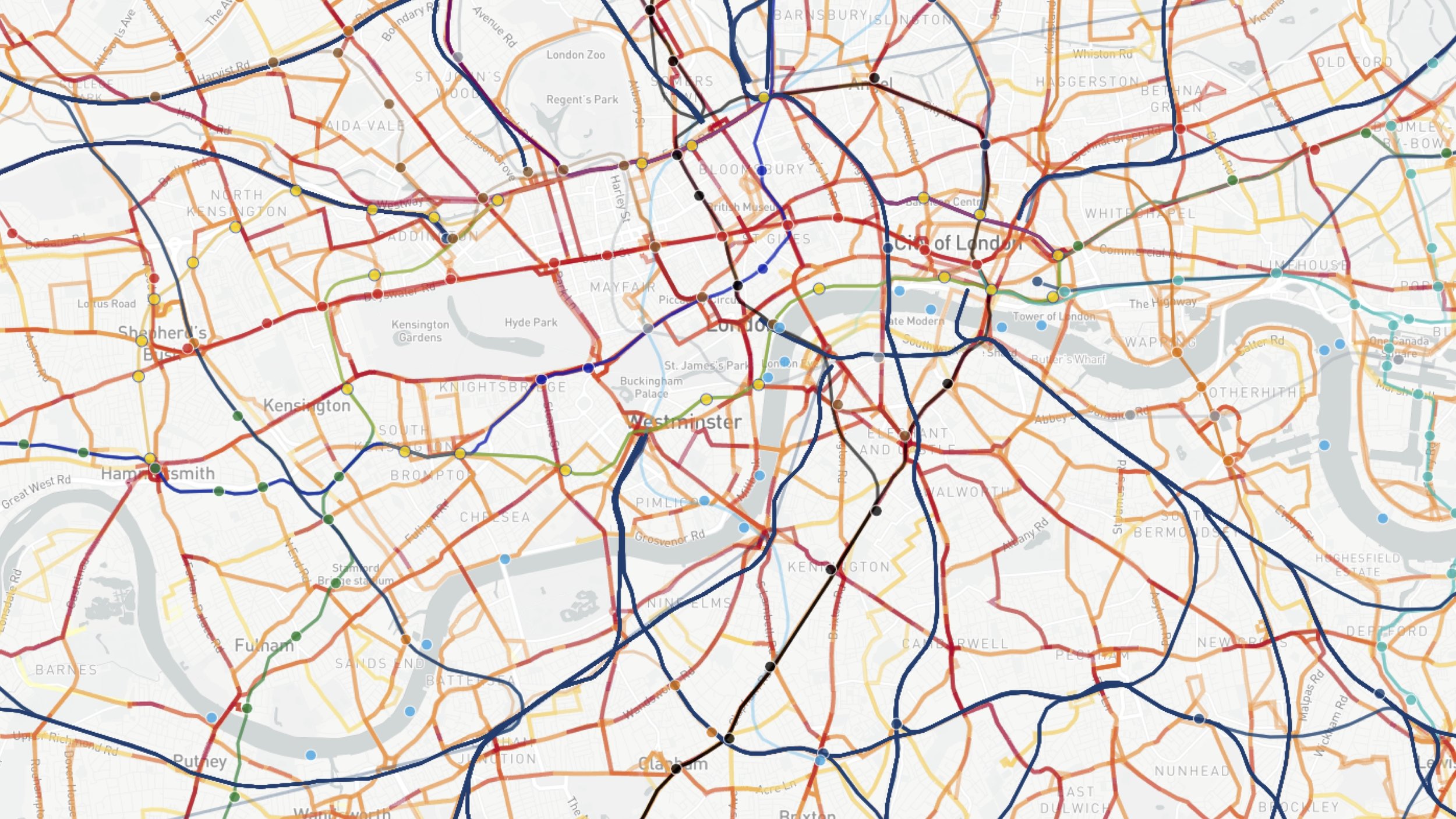
“Now let’s add the bus network.”

“Now let’s add the cab network.”

“Now let’s abstract that and play this live data over 24 hours. This is smart citizens in their city. This is their data. This is open data.”

“What open data does is allow the city to remain transparent. It allows the city to become an ecosystem in which the citizenship can build products. Products solve the problems of the city, which in turn makes the city more accessible, which in turn allows the citizenship to change the city.”

As I said just before - this is their data. It is not yours to own. It is owned by the citizen themselves - it is their data, their experiences, their interactions - but this data isn’t just ‘there’ for no reason. It’s there because the smart citizen wants and needs the city to react to them. So how does this stack up?

“Smart cities aren’t ‘Information Technology’. Nor is this an investment in infrastructure, servers and departments. Data is normalised now, and it’s been normalised by the citizen networks. Cities have to embrace this - a world of dynamic constantly augmented data and APIs - in order to embrace cultural change and the needs of the citizen. If they fail, they risk not being able to speak for their citizens, and fail to to adapt the city to their needs.”

“Unfortunately - sorry - it’s not enough to just ‘build APIs’. Or to build user interfaces for those APIs. As the smart city evolves, and as the citizens evolve, the products within the city must evolve also. An autonomous future of transit maybe inevitable, but the products that make sense of this automation, that interact with the human become more important. Autonomy and data solve the problem of the network, but they create the problem of human understanding, human interaction, and the need of the lizard brain - the default - the ‘do without thinking’.”
“Also, unfortunately - Change is hard. Allowing a change towards new systems and behaviours, such as automation - is difficult. The smart citizen wants change, but must learn how to interact with it. It is better UX to adopt existing networks - and using data - build feedback loops to allow for mutual innovation. It is not enough to just provide autonomous transit based on smart citizen data and expect the citizen to interface with it. Where is the trust?”

“Luckily we have an example of interfacing this change. The pop up has become a great form of validation in retail. It’s a way of validating business models, citizen acceptance, story telling, and a way to get the network of a city to try, test, validate and understand something. To feedback on it. To critique it. To discuss it. To see the resulting iteration. To tell a story. The citizens social network proof articulates and accelerates acceptance.”

And this brings me to Smartbus.

“Last month Citymapper began to experiment in mass transit using the concept of pop ups to validate a number of things. Theories, concepts, user experience, and user acceptance. This was a 3.7 tonne beta release that was designed as a giant feedback loop. This is because change in smart cities doesn’t happen with a big ‘wow’ product. It happens through these feedback loops and fear reduction - simplification, narrative and network acceptance. Who will get on this bus? Will they trust it? What will they think? What is it worth?”

“However, Smartbus was also a number of things. A full stack of experiments. We built tools to analyse smart citizen data, tools to manage operations, tools to aid driver confidence and communication, and tools to evaluate the vehicle performance. So…here’s what makes a smartbus smart.”
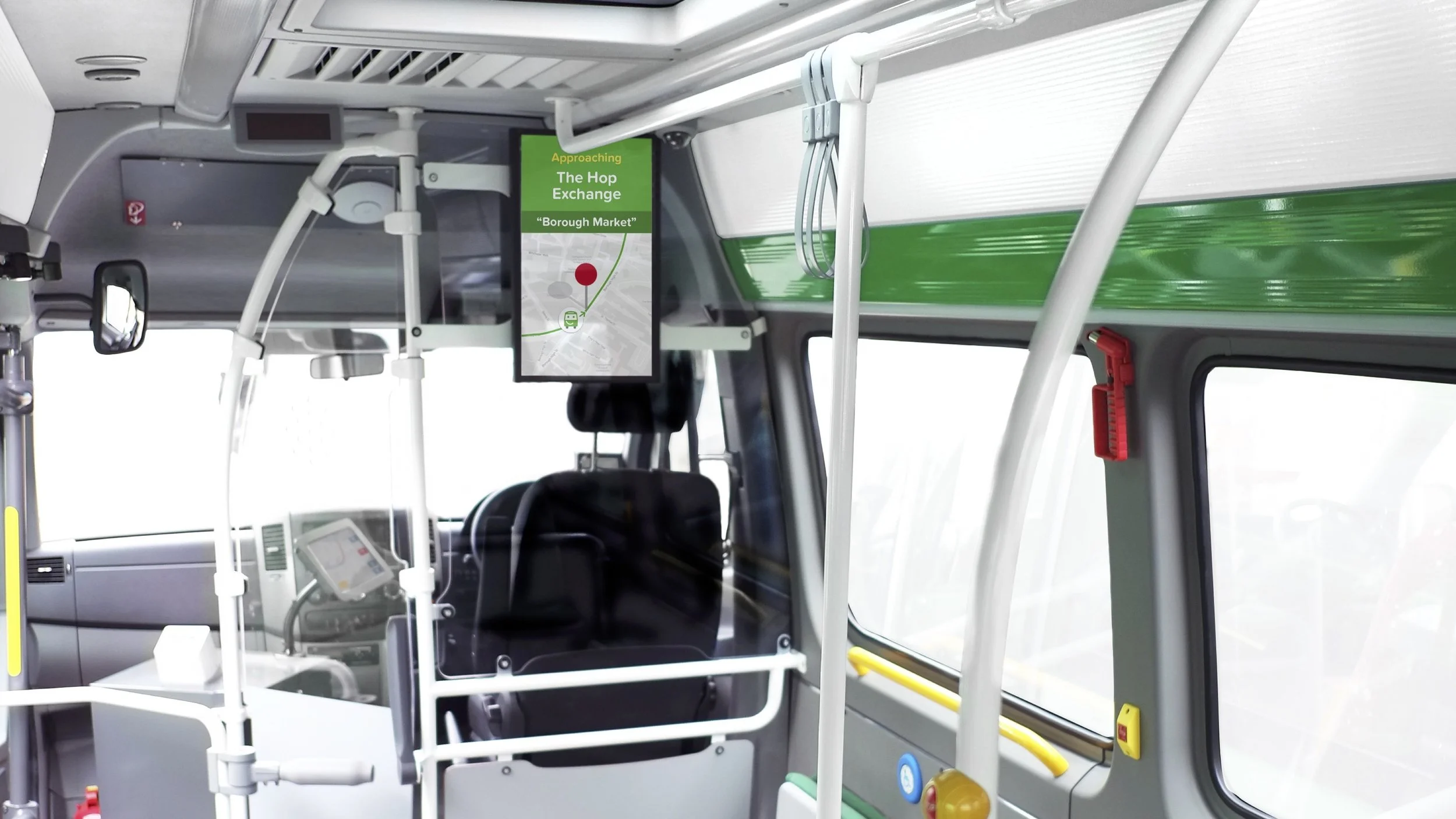
“We created interfaces to reduce fear and to inform.”
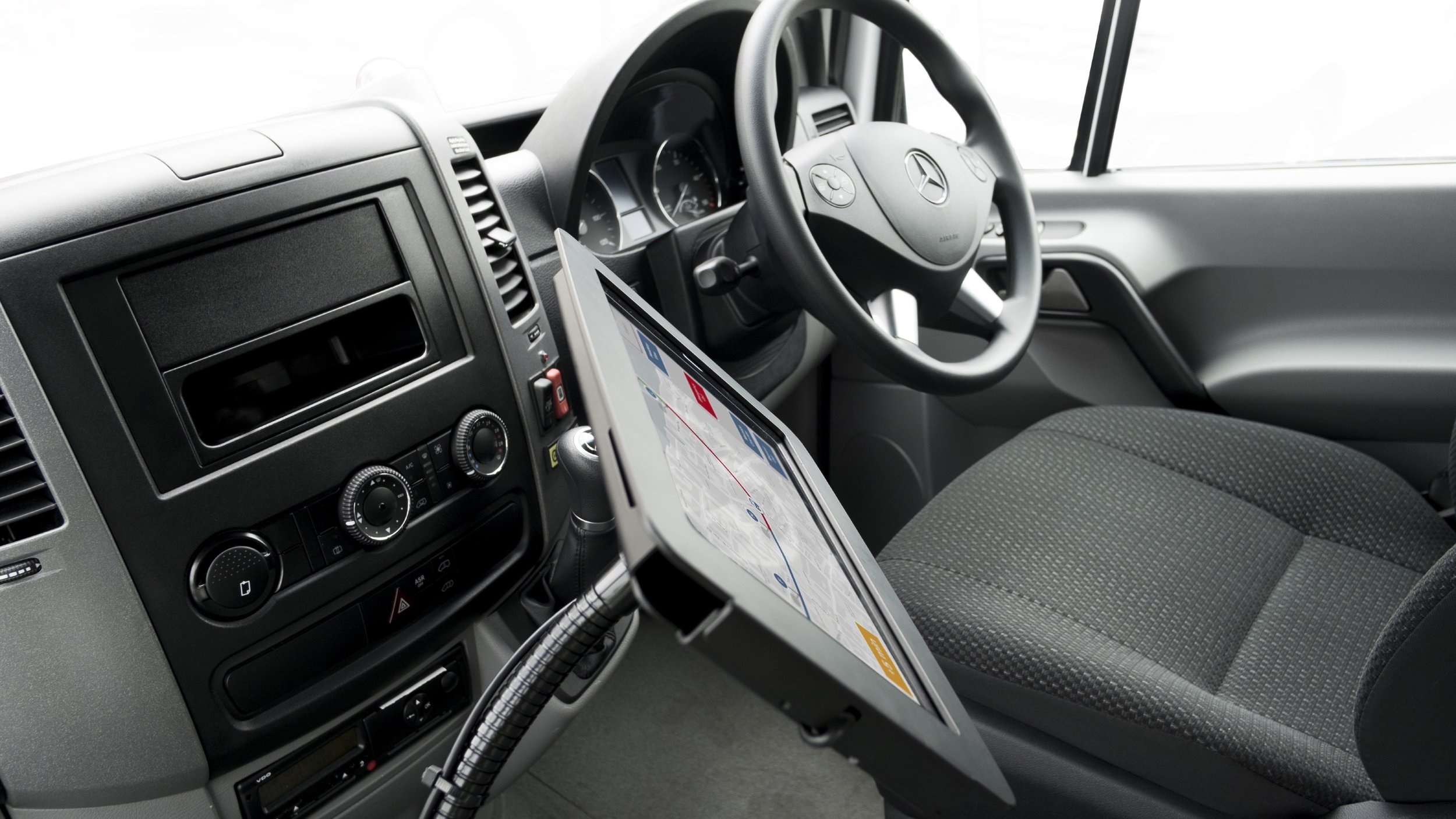
“We created interfaces to improve driver feedback, communication and customer experience.The driver is key in an non-automated world, they captain the ship, and they are responsible for the bus being on time, keeping people safe, and getting them where they want to go.”

“We showed where the bus was, where it was going, when it would get there - using live traffic data to calculate accurate ETAs. We showed the driver name, and this increased customer interaction.”

“We even were transparent when our buses got lost or weren't in operation. Honest is a great policy. If you’re using citizen data to create experiences, telling them when you get it wrong is important.”

“We developed personal interfaces for the smart citizen in our app, showing the buses in real time on a map, and giving real time traffic ETAs.”

“And we provided feedback loops for our users to suggest routes online. The reason we did most of this is because you can’t understand Smart cities with data alone. Smart citizens and products like ourselves can navigate with data, but we can’t understand the city or the unique users predicament, so we used Smartbus to begin a process of understanding mass transit better. What mass transit could be. What it could become in a smart city.
We learned some stuff too.”

“London is not a new city, but it’s one we understand best. If we had to design a future city, we could design it around transit and demand, but in London we began with a city with exiting infrastructure - in fact some of the best in the world. So if you begin with a city that has infastructure already - like you do in HK - then it is about optimising that exiting infastructure. Using the city itself and it’s citizens to develop human focused transit systems that are complimentary and are designed though human and data based feedback.”

“It’s important to recognise that cities already have a user experience, so it’s about working within that expected experience, the expectation of the citizen. Within this expected UX is the opportunity to optimise, to change, to iterate. This UX is a tangle of complex networks, nodes and varied user expectations.”

“But thats not to say that change of that user experience is impossible, it’s just hard. Transit *does* change in the smart city because of the smart citizens feedback, but infastructure cannot change or iterate at the speed of a digital product or interface - or the wants of the Smart Citizen. New roads, new metro systems, new stations - user interfaces change quicker, meaning the interface becomes more useful and adaptable than the infastructure. So what does this mean for the smart city?”

“It means that in a city where the interface changes quicker than the infastructure, that navigating and networking in a city becomes focused on the interface. And it means that the city becomes owned by the smart citizen using those interfaces. These interfaces become focused on navigation by destination. That means “Get me to there”, rather than the process of “getting there”. It means simplifying the city to destination, demand and the data.”

“But what does this change look like? We’re creating navigation, simplification, and we’re exploring on-demand transit within existing cities. If we place the smart citizen and their data at the centre of the smart city, as part of creation and execution of transit, how does this transit look? How does the city adapt?”

“This is not longer about interacting with a metro map, or trying to use interfaces to figure out navigation, or to work out where the bus goes. This is a user interface that adapts to the citizen, that takes you where you want to go. Now, I recognise there are some here thinking this is the description of UBER or similar, but UBER uses an existing system - the taxi - and layers new technology on it. But the smart city needs mass transit. Mass transit that adapts to the city and it’s citizens, not single occupancy vehicles that adapt to the needs of the individual.”
